
February 20, 2026
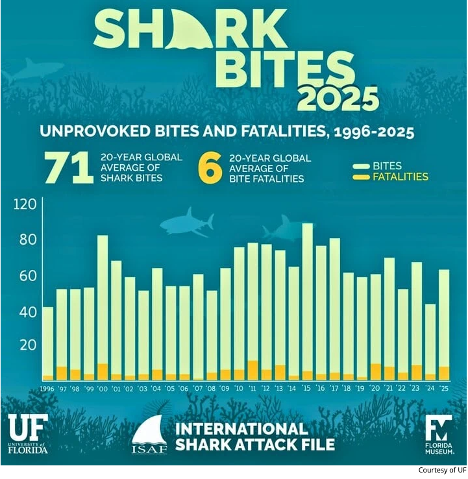
Global shark attacks were higher in the year 2025 over 2024 reports the Florida Museum of Natural History’s International Shark Attack File (ISAF). The annual study indicates that global shark attacks are up from last year, but are similar to numbers documented over past decades.
The 2025 worldwide total of 65 confirmed unprovoked cases is close to the most recent five-year (2020-2024) average of 61 incidents annually. Fatalities were higher in 2025 with nine unprovoked fatalities compared to an average of six. The total number of human-shark bites in 2025 is below the 10-year average of 72.
2024 was a statistical low where the ISAF recorded 47 confirmed unprovoked shark bites globally, marking it a significant decline from recent years and falling below the 10-year average. Of these, four resulted in fatalities, with 28 of the total attacks occurring in the U.S. in 2024. Globally, swimming and wading is the highest risk category of being bitten, with 46% in 2025.
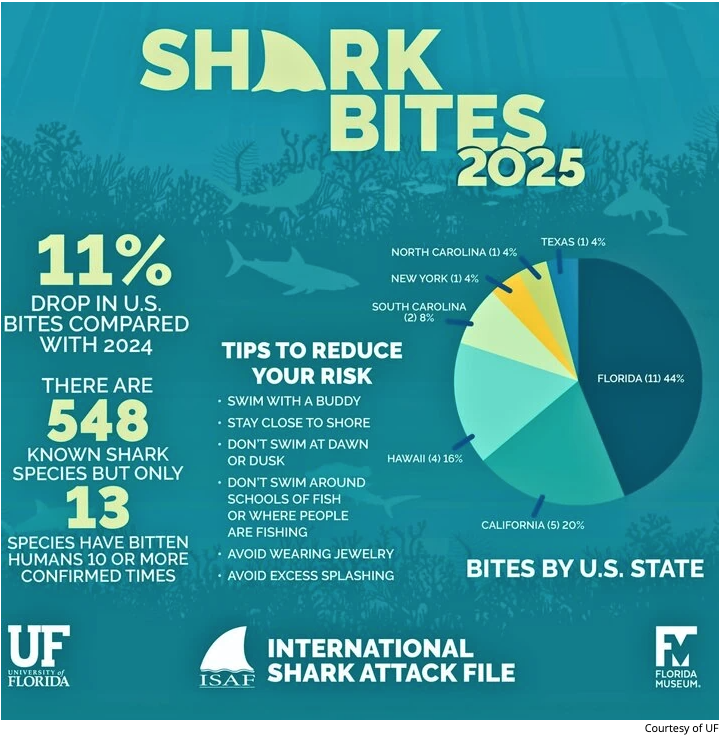
A total of 25 incidents occurred in US waters, with the highest number in Florida at 44%. The United States reported 38% of shark bites worldwide in 2025, a decrease from over 50% since 2019. The USA experienced one fatality in 2025 out of the total of nine globally. Over the past five years, the number of unprovoked bites in the United States has actually decreased.
Australia followed closely behind the United States, with 21 of last year’s total shark bites. It was notably higher than the most recent five-year annual average of 13 incidents for the country. Australia recorded an unusual 5 unprovoked shark bite fatalities in 2025, all from white sharks. With a large coastline and high ocean activity among Australians, the country also has temperate and tropical waters hosting all of the “Big Three”: Tiger sharks, Bull Sharks, and White sharks. These three species are associated with 65% of all unprovoked and provoked incidents of the nearly 1000 encounters recorded by the ISAF.
The ISAF defines unprovoked and provoked categories as follows:
- “Unprovoked bites” are defined as incidents in which a bite on a live human occurs in the shark’s natural habitat with no human provocation of the shark
- “Provoked bites” occur when a human initiates interaction with a shark in some way. These include instances when divers are bitten after harassing or trying to touch sharks, bites on spearfisherman, bites on people attempting to feed sharks, bites occurring while unhooking or removing a shark from a fishing net and so forth.
“Shark bites are the consequence of the biology of the animals, the climatic conditions and the number of people in the water, at the time of the incident. These global patterns change only slightly from one year to the other. But the regional incidents do oscillate a lot, and these local trends are interesting.” Gavin Naylor, director of the Florida Program for Shark Research at the Florida Museum of Natural History
Risk in California
Although swimming has the highest number of incidents globally, California experiences more shark encounters with surfers on average. California also experienced an uptick in shark encounters in 2025, with 10 unprovoked encounters, up from 8. Four swimmers were bitten in California waters. Of those, two received no injury, one a minor injury on the hand and arm. One was fatal, tragically suffered by marathon swimmer Erika Fox in Monterey. Of all shark -related incidents recorded by the California Department of Fish and Wildlife since 1950, 41% of those were swimming related, with 7 fatalities. Surfers and those participating in board sports accounted for 30% of the incidents in the Golden State, and with a total of 5 fatalities (29%). Surfing grew as a sport in the 1970s, and if one compares the same amount of fatalities to swimming since 1970, swimmers experienced four fatalities with 5 surfers over the same period.
Three surfers were involved with sharks in 2025, two without injury, and one with major injuries while surfing at Salmon Creek in Sonoma County. A 2015 Stanford study indicated that swimmers have the lowest risk of attack compared to other ocean users (e.g., divers, surfers), with odds of about 1 in 738 million per beach visit.
The chances of being bitten by a shark remain extremely low. Death by drowning is far more common. According to the World Health Organization, drowning is the third leading cause of death from unintentional injury worldwide. In the United States alone, the CDC reports over 4,000 drowning deaths a year. According to the California Water Safety Coalition, 12,588 California residents died from drowning between 1991 and 2020. Over the last 75 years, 7 swimmers have died from Shark Attack in California, according to California Fish and Wildlife record keeping.
Sharks in Decline
Despite the attention it gets when an incident involving a shark and human occurs, shark populations are decreasing globally. Globally shark mortality has been estimated to at least 76 to 80 million sharks between 2012 and 2019. Around 25 million of those were from threatened species.
It is estimated that 71% of all oceanic shark species have been fished out since 1950.
The decline in shark numbers is largely due to overfishing and fueled by the demand for shark fins. Warming seawater temperature and conditions are also shifting shark distributions, which can create the appearance of sudden population spikes locally, such as in Florida coastal waters. A decline in prey population can lead to competition between fishing and sharks, leading to what fishermen call depredation. These fishermen claim shark populations are exploding and is leading to short-sighted policy like The Safe Seas Act, that would weaken shark protection in Florida, with potential ramifications in all US waters.
How to Improve Your Odds
White sharks have been responsible for all documented fatalities in California, according to the California Department of Fish and Wildlife. Since accurate investigatory record keeping began in 1950, out of 233 incidents, there were 17 fatalities over the 76 years of data. This averages to around one fatality for every five years in California waters. Shark Stewards offers the following tips to decrease the odds of a white shark encounter in California, where nearly all unprovoked incidents are from white sharks.
White sharks have a unique behavior and many of the general precautions, for example higher risk fo activity at dawn and dusk do not apply. Some general suggestions do apply, like swimming or surfing with a buddy, staying away from people fishing, and avoiding areas of high seal activity, especially near haul outs.