
Sharktober, the Red Triangle, and What California Ocean-Goers Should Know
September 14, 2025, © David McGuire
As the fall season arrives along California’s coastline, a compelling and cautionary period for ocean-goers occurs when adult great white sharks return to California waters. These fall months coincide with an increase in human -shark interactions and a few, but rare, high profile human shark interactions, (aka shark attacks.) Here we discuss the incidence of great white shark human interactions* along the West Coast of North America, the relative risk and how to avoid becoming the next statistic.
Scientists and shark conservation organizations like Shark Stewards call this period “Sharktober” to describe the period of heightened great white shark (hereafter called white sharks) activity and human encounters along the California coast. This surge is driven by the return of mature sharks following an annual migration from the remote “White Shark Café” in the central Pacific. After swimming nearly 5000 miles round-trip, the mature white sharks return to the coast to forage near seal colonies along central California.1
This makes September through November the months with the maximum probability of large white shark sightings or interactions. During these months, the central coast is a hotspot for white shark activity. Known as the Red Triangle, the area spanning from Bodega Bay west to the Farallon Islands and south to Big Sur has the highest number of white shark bites on people recorded worldwide. Approximately 38% of U.S. great white shark attacks on humans, around 11% of the global total, have occurred in this region.
Moreover, scientific analysis shows that 80% of attacks on humans along California’s coast occurred from Humboldt County south to Monterey County, with 62% concentrated between Marin and Monterey counties, illustrating the region’s role in the state’s human-shark interactions.2
Recent Attacks & Fatality Overview
On average, California experiences fewer than three great white shark incidents per year. According to the California Department of Fish and Wildlife, there have been 225 shark incidents in California involving all species of sharks, at least 197 of which involved white sharks.3 Of those, 16 were fatal. All of the fatalities likely involved white sharks over the 75 year period recorded. The last fatal white shark attack in California occurred on October 5, 2023 when kite sailor Felix Louise D’Jai disappeared while swimming in shallow water at the Point Reyes National Seashore. Witnesses reported a large shark grasping onto Mr. D’Jai, whose body was never recovered. Prior to that December 24, 2021, bodyboarder, Tomas Abraham Butterfield (age 42), was fatally attacked in Morro Bay. A coroner confirmed injuries to his head, chest, and shoulder, and DNA analysis affirmed a great white shark was responsible. Fatalities from white sharks average every 3 years along the west coast. Globally, 2024 was a year of reduced human fatality from an average of 10 to 4. The Florida Museum of Natural History’s International Shark Attack File investigated 88 alleged shark-human interactions worldwide in 2024. ISAF confirmed 47 unprovoked shark bites on humans and 24 provoked bites. One fatality was in the USA in Hawaii from a tiger shark. The USA experienced no fatalities from white sharks in 2024. Globally, two of the four confirmed 2024 fatalities were from white sharks, one in New Zealand, the other Australia. Both victims were hunting at the time of the attack. 3
Population Recovery & Northward Range Extension
Historically, impacts from nearshore fisheries, a decline in prey and habitat loss reduced the population of white sharks in the Northeast Pacific significantly. The retaliatory “Jaws” effect, with white shark tournaments in the 1980s, a commercial fishery and loss as bycatch in near-shore driftnet fisheries (now banned in California) added to the dramatic decline in the white shark population in the NEP. Following protections that began in California in 1994, and with an increase in marine mammal prey (thanks to the Marine Mammal Protection Act), white sharks have been making a comeback in this population.4
- The central California white shark population has been estimated at around 300 individuals by Kanive et al in 2023. Most of these sharks counted in this study were adults and subadults.5
- Total population estimates, including juveniles and subadults in Mexico and the US west coast have been estimated to range from 2,000 to a high of 3000. 6
- Since 2015, juvenile sharks been increasingly spotted north of Point Conception-a range shift partly attributed to warming ocean temperatures and climate phenomena.7
- Notably, the largest segment of the population consists of juvenile and young-of-year sharks. Historically confined to Southern California, these smaller sharks have increased in numbers and sightings northwards as far as Santa Cruz.
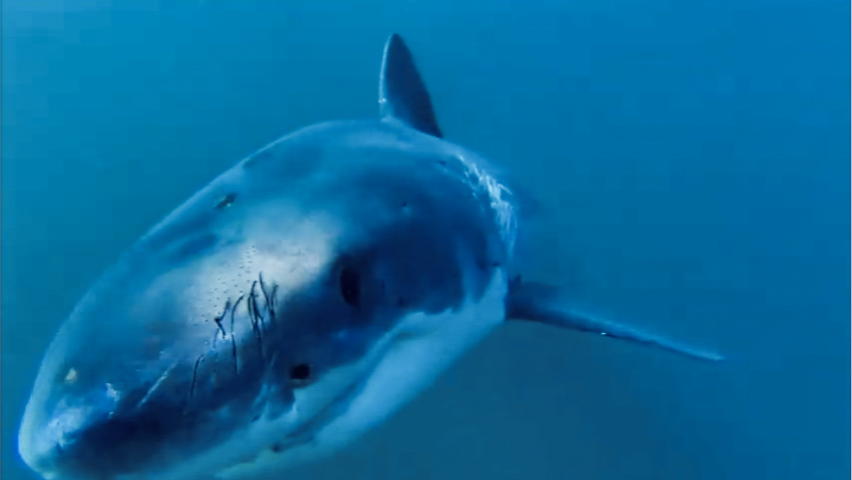
White Shark Investigates onboard camera SE Farallon Island Under permit NOAA White Shark Stewardship Program ©Sharkstewards
Stanford Study: The Risk Still Very Low
Although the shark population of white sharks is increasing, and observations, especially in Southern California the white shark nursery, encounters are low and risk is low. A 2015 Stanford-led study underscores that, despite growing numbers of recorded encounters, the individual risk remains exceptionally low:
- Surfers face about a 1-in-17 million chance of being bitten;
- Scuba divers are nearly 6,900 times more likely to be hospitalized for decompression sickness than bitten by a white shark;
- Ocean-goers are 1,817 times more likely to drown than be attacked.
This risk drops further if ocean users avoid high‑risk seasons (like Sharktober) and regions. 9
As Chris Dr. Lowe reports, interactions and observations of white sharks near humans have been increasing as the population of white shark is recovering in Southern California. The waters of Southern California serve as a nursery site and juvenile and young of year aggregate nearshore in areas of high human activity. However, despite a large public recreational use and an increased seasonal humans and sharks overlap where aggregations form in southern California, the number of unprovoked shark bites across southern California remains extremely low.
Globally, white shark populations are on the decline, with the population in the Mediterranean extirpated, and others off South Africa and Australia declining. Last assessed in 2018, white Sharks are listed on the International Union for Conservation of Nature (IUCN) Red List, as Vulnerable. Protected since 1994, California law states that White Sharks may not be taken. While White Sharks are not listed under the U.S. ESA, they are listed under Appendix II of the Convention on International Trade of Endangered Species of Wild Fauna and Flora (CITES). Species listed in Appendix II of CITES are those species that are not necessarily threatened with extinction but may become so if trade in these species is not regulated.
Greater numbers of adult white sharks returning to the central California coast in the fall, increases the probablility of encounters along the California coast, especially in October and within the Red Triangle. Even so, the chance of being attacked remains extraordinarily low. Awareness, timing, location selection, and common-sense precautions, like those advocated by Shark Stewards below, empower ocean-goers to reduce any risk further while coexisting with this vital apex predator.
Shark Stewards’ “Ten Steps” to Avoid Great White Encounters
Shark Stewards recommends ten practical measures to reduce the already low risk of a shark encounter-especially during Sharktober or in high‑activity areas:
- Avoid water activity in areas with seals or seal haul-outs.
- Don’t enter water in known high shark‑activity zones during fall months (e.g., Point Conception, Dillon Beach, Point Reyes, Ano Nuevo).
- Watch nature’s signals: circling birds, splashing water, dead whales, or feeding marine mammals may indicate sharks nearby.
- Use the buddy system—victims often obtain immediate aid and have a higher rate of survival.
- Avoid resembling shark prey: darker silhouettes blend in—patterned wetsuits or boards may help, though not proven for all species.
- Be cautious at low light (dawn, dusk) when sharks feed visually. However, white shark activity is highest in the early afternoon.
- Steer clear of river mouths or murky areas, where visibility is poor.
- Avoid bleeding in water. If bleeding exit the water. Small cuts or menstruation-related risks are uncertain.
- If you spot a shark, alert others, paddle calmly without splashing, and exit the water.
- Heed the signs: beach postings warning of sharks, news stories and social alerts (like tweets tagged #SharkWatch) can provide real-time information.
* Instead of shark attack we use the term interaction or incident. An interaction can be an investigation with or without contact. The California Department of Fish and Wildlife (Department) instead uses the term “incident,” defined as interactions where a shark touches a person, their board, or kayak, without provocation and with or without causing injury.
References
1. Jorgensen SJ, Reeb CA, Chapple TK, Anderson S, Perle C, Van Sommeran SR, Fritz-Cope C, Brown AC, Klimley AP, Block BA. Philopatry and migration of Pacific white sharks. Proc Biol Sci. 2010 Mar 7;277(1682):679-88. doi: 10.1098/rspb.2009.1155. Epub 2009 Nov 4. PMID: 19889703; PMCID: PMC2842735.
Francesco Ferretti, Salvador Jorgensen, Taylor K Chapple, Giulio De Leo, Fiorenza Micheli Reconciling Predator Conservation With Public Safety- Frontiers in Ecology and the Environment 10 August 2015 https://doi.org/10.1890/150109
2. Ugoretz J, Hellmers EA and Coates JH (2022) Shark incidents in California 1950-2021; frequency and trends. Front. Mar. Sci. 9:1020187. doi: 10.3389/fmars.2022.1020187
Domeier ML, editor. Global perspectives on the biology and life history of the white shark. CRC Press; 2012 Feb 3.
3. Naylor, Gavin International Shark Attack Files Florida Museum of Natural History https://www.floridamuseum.ufl.edu/shark-attacks/yearly-worldwide-summary/
4. Lowe, C. G. et al. Historic fishery interactions with white sharks in the Southern California Bight. Global Perspectives on the Biology and Life History of the White Shark’.(Ed. ML Domeier.) pp, 169–186 (2012).
5. Paul E. Kanive, Jay J. Rotella, Taylor K. Chapple, Scot D. Anderson, Timothy D. White, Barbara A. Block, Salvador J. Jorgensen, Estimates of regional annual abundance and population growth rates of white sharks off central California, Biological Conservation, Volume 257, 2021, 109104,
ISSN 0006-3207, https://doi.org/10.1016/j.biocon.2021.109104.
(https://www.sciencedirect.com/science/article/pii/S0006320721001567)
6. Burgess GH, Bruce BD, Cailliet GM, Goldman KJ, Grubbs RD, Lowe CG, et al. (2014) A Re-Evaluation of the Size of the White Shark (Carcharodon carcharias) Population off California, USA. PLoS ONE 9(6): e98078. https://doi.org/10.1371/journal.pone.0098078
7. Rex PT, May JH III, Pierce EK, Lowe CG Patterns of overlapping habitat use of juvenile white shark and human recreational water users along southern California beaches
(2023) Patterns of overlapping habitat use of juvenile white shark and human recreational water users along southern California beaches. PLOS ONE 18(6): e0286575. https://doi.org/10.1371/journal.pone.0286575
8. Tanaka, K.R., Van Houtan, K.S., Mailander, E. et al. North Pacific warming shifts the juvenile range of a marine apex predator. Sci Rep 11, 3373 (2021). https://doi.org/10.1038/s41598-021-82424-9
9. Francesco Ferretti, Salvador Jorgensen, Taylor K Chapple, Giulio De Leo, Fiorenza Micheli Reconciling predator conservation with public safety, Frontiers in Ecology and the Environment, August 2015